
The Sales Meeting, End to End
I spent a year building meeting agents at Aida. These are the four problems that were harder than they looked, with what worked, what failed, and what is still open.
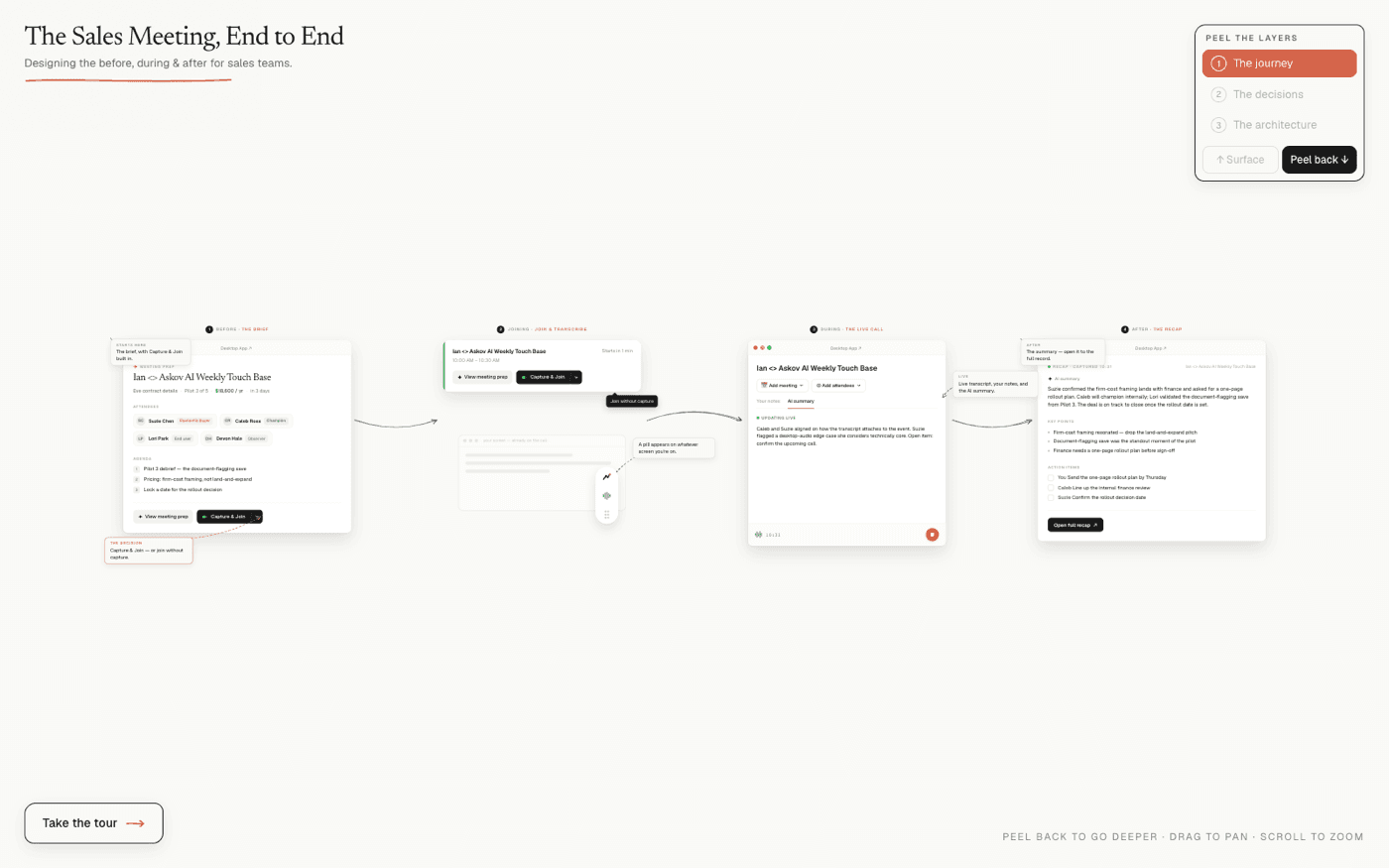 Explore the interactive version
Pre-reads
A brief that primes you for a meeting from prior context.
It’s not summarization — it’s entity resolution. The hard part was the brief being about the right person, deal, and context. A gorgeous brief on the wrong company kills trust.
A pre-read snapshots something that won’t hold still. New meetings stack up; the context graph moves. Static briefs rot in days — freshness is the whole problem.
- Calendar-triggered briefs at 24 hours and 10 minutes before.
- Attendee-scoped, not deal-scoped — how people walk into a room.
- Account-level synthesis for execs, not stacked deal summaries.
- Dossiers sometimes surfaced the wrong company — the worst failure mode.
- Research panels went blank for tenants who never set up config.
- Static summaries drifted from live data and started misleading.
Entity resolution and tenant config are the silent killers — not summary quality. The model output was fine. The metadata around it broke things in the field.
Diarization
Reliable speaker labels and clean transcripts, live.
Raw accuracy barely matters. Segmentation stability does — whether who-said-what holds still. A transcript reads fine to a human and is still quietly broken underneath.
Everything downstream trusts that segmentation. When it drifts, nothing errors — it just rots, and you find out three features later.
- Recall identity-based diarization live, plus a Gladia async pass for fidelity.
- Custom vocabulary for product and people names — fed in sparingly.
- Native Zoom recording when available, instead of fighting it.
- Aggressive custom vocab destroyed fidelity. Same-day revert.
- Merging transcript sources silently broke speaker attribution.
- A Google Meet diarization bug bit us for weeks. Multi-speaker-in-one-room never got solved.
One stable transcript beats a richer merged one. The brittle part is what runs on top — not the transcript. Optimize for stability, not pretty text.
Notes & storage
Store meeting outputs so they can power everything downstream.
Most “quality” complaints weren’t the model. They were wiring and metadata — the note landed in the wrong place, shape, or entity. The output was usually fine.
Where a note lands decides what you can build on it. Week-one schema opens and closes doors. Get it wrong and you migrate everyone’s history.
- Event-scoped notes as work items, auto-archived after three days.
- Per-customer template configs that matched how each team works.
- Summary-only or full-transcript writeback — the customer’s choice.
- Raw transcripts in one text field: character limits, felt untrustworthy.
- Long-running notebooks just accumulated — nobody could find anything.
- Flaky auto-send recaps destroyed trust faster than any quality bug.
Format and destination is unsolved industry-wide. Notebook, per-entity summary, or event-scoped artifact — each unlocks different downstream. No neutral default, so choose early and deliberately.
Action items
Turn meeting outputs into things people actually execute.
Prescribing actions kills trust fast unless accuracy is very high. One confidently wrong to-do and the whole list is dead to them.
There’s no universal action shape — it’s vertical-specific. Sales wants nothing like ops or product. The structure is the whole thing, different per customer.
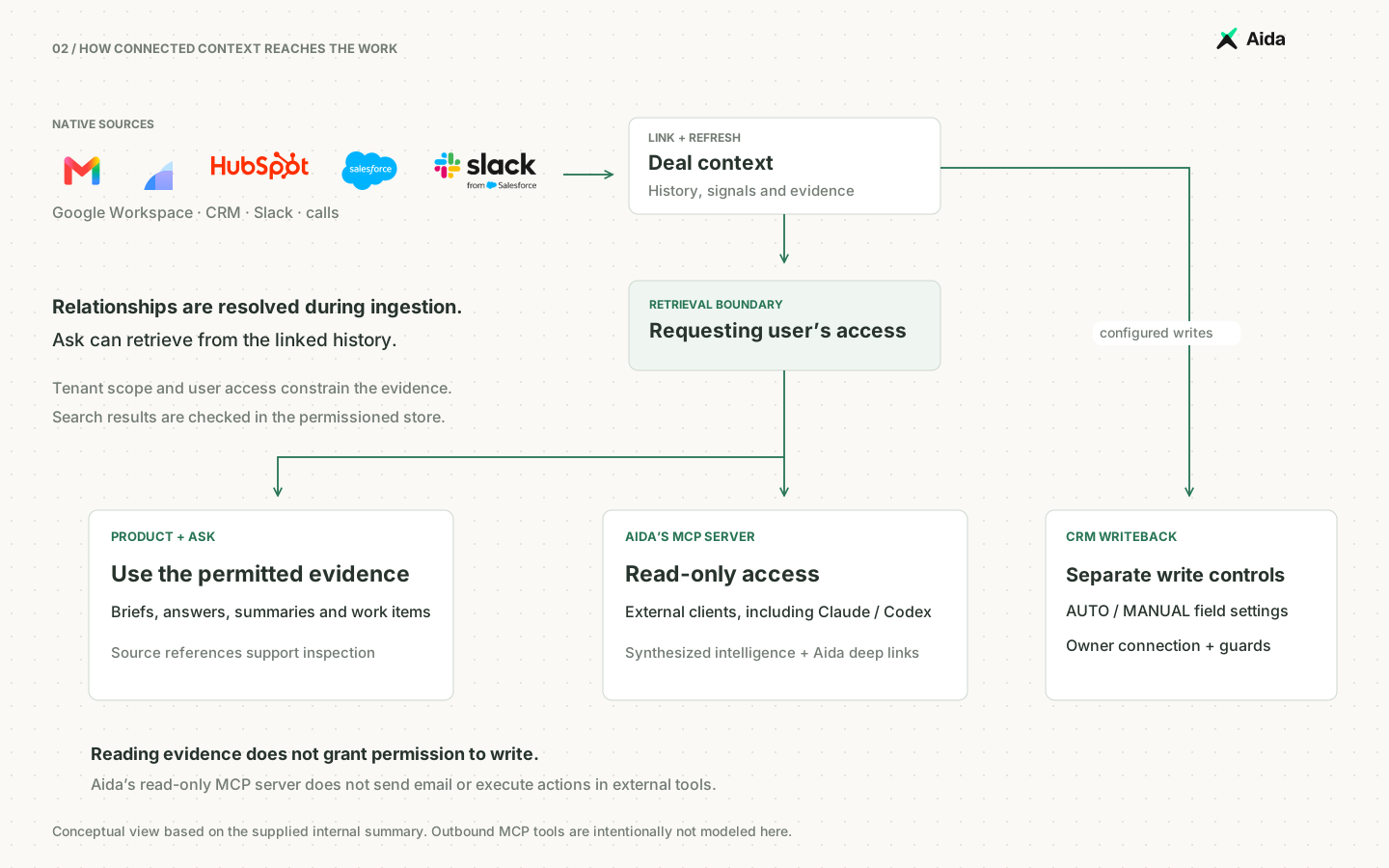
Preparing follow-up emails in Ask
Asking Aida to prepare follow-ups for a pilot, a technical discussion and a business case.
- Per-field AUTO vs MANUAL, so only low-risk fields auto-execute.
- Style-only edits — AI changes tone, never facts.
- Confirm/cancel cards for irreversible actions. Biggest unlock: user-curated scaffolds — templates, custom instructions, weekly reports the AI just fills. Adoption jumped when users owned the structure.
- Generic AI action lists got ignored as noise.
- Low-value follow-ups cluttered tasks until people tuned out.
- Bot-voice recaps that did too much got rejected.
Let users build the scaffold; let AI fill it. Don’t let AI decide someone else’s workflow — sales isn’t ops isn’t product. Hand structure to whoever owns the work.